
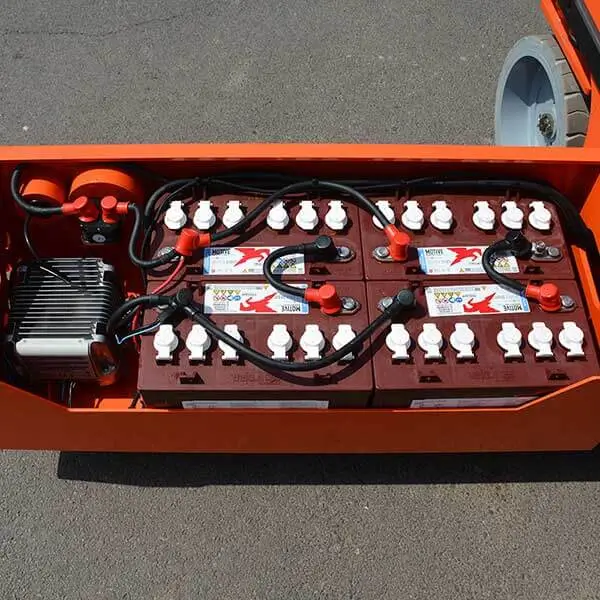
Choosing the right scissor lift battery technology is one of the most vital decisions when configuring electric aerial work platforms for rental fleets, facility maintenance, and indoor construction. Power systems directly dictate daily operational runtime, charging speed, maintenance overhead, and total cost of ownership.
While traditional flooded lead-acid batteries have served as the industry standard for decades, modern lithium-ion (LiFePO4) power systems are rapidly gaining market share due to zero maintenance, opportunity charging capability, and extended service life.
In this comprehensive guide, we compare traditional lead-acid and lithium options to help buyers select the optimal scissor lift battery setup for maximum jobsite uptime.
Table of Contents
- Overview of Scissor Lift Battery Technologies
- Lead-Acid vs. Lithium-Ion Scissor Lift Battery Comparison
- Charging Efficiency and Opportunity Charging
- Maintenance Overhead and Water Topping Requirements
- Lifespan, Cycle Count, and Total Cost of Ownership
- Performance in Cold Weather and Harsh Environments
- How to Choose the Right Battery for Your Fleet
- Frequently Asked Questions (FAQ)
- Conclusion and Next Steps
Overview of Scissor Lift Battery Technologies
The performance of any electric elevating work platform relies heavily on its energy storage chemistry. When evaluating a scissor lift battery replacement or configuring new factory orders, three primary chemistries are available:
- Flooded Lead-Acid (FLA): The traditional deep-cycle battery design requiring regular distilled water topping, equalizer charging, and strict ventilation during recharging cycles.
- Absorbed Glass Mat (AGM / Gel): A sealed lead-acid variant that eliminates liquid watering requirements but remains sensitive to deep discharges and slow charging curves.
- Lithium Iron Phosphate (LiFePO4): Modern sealed lithium technology offering high energy density, fast charging, integrated Battery Management Systems (BMS), and maintenance-free operation.
Lead-Acid vs. Lithium-Ion Scissor Lift Battery Comparison
Understanding technical differences allows equipment managers to balance initial purchase price against long-term fleet operating costs when choosing a scissor lift battery power system.
| Feature / Metric | Flooded Lead-Acid (FLA) | AGM (Sealed Lead-Acid) | Lithium-Ion (LiFePO4) |
|---|---|---|---|
| Average Cycle Life (80% DoD) | 500 – 800 Cycles | 600 – 1,000 Cycles | 3,000 – 4,000+ Cycles |
| Full Recharge Duration | 8 to 12 Hours | 7 to 10 Hours | 1.5 to 3 Hours |
| Daily Maintenance | Distilled water checks required weekly. | Maintenance-free (Sealed). | Zero maintenance (Sealed). |
| Opportunity Charging | Not recommended (shortens cycle life). | Limited flexibility. | Fully supported without memory effect. |
| Battery Management System (BMS) | None (External Charger dependent). | None. | Integrated smart BMS protection. |
| Weight Impact | Heavy (Acts as chassis ballast). | Heavy. | Up to 60% lighter (Steel ballast added). |
When selecting machines with different weight distributions and chassis designs, refer to our comprehensive scissor lift load capacity guide.
Charging Efficiency and Opportunity Charging
Charging habits significantly impact daily productivity. Traditional lead-acid setups require a full 8-hour charge cycle followed by an 8-hour cooling period, restricting machines to single-shift availability unless battery trays are swapped manually.
In contrast, modern lithium scissor lift battery systems support opportunity charging. Operators can plug in during lunch breaks or shift changes without degrading battery cells or reducing total cycle life.
- Fast Charging Capability: High-output smart chargers can replenish a lithium battery pack to 80% state of charge in under 1 hour.
- Energy Efficiency: Lithium systems operate at 95%+ round-trip charge efficiency compared to 70–80% efficiency in flooded lead-acid units, lowering utility electricity consumption.
If you are planning to import electric machinery directly from factory suppliers, explore our detailed buyer’s guide on importing scissor lifts from China.
Maintenance Overhead and Water Topping Requirements
Neglecting routine maintenance is the leading cause of premature lead-acid scissor lift battery failure. Flooded cells require disciplined watering schedules using distilled water, cleaning acid residue from terminals, and periodic equalization charges.
Lithium-ion power packs eliminate these manual touchpoints entirely:
- Zero Watering Needed: Eliminates labor costs associated with manual battery watering programs across large rental fleets.
- No Acid Corrosion: Prevents battery tray rust, wire harness damage, and acid spills on warehouse concrete floors.
- Integrated BMS Monitoring: Electronic controllers automatically protect cells against overcharging, deep discharge, short circuits, and thermal runaway.
To evaluate overall equipment pricing across lead-acid and lithium machine options, review our electric scissor lift price guide.
Lifespan, Cycle Count, and Total Cost of Ownership
While a lithium scissor lift battery carries a higher initial purchase price compared to standard lead-acid packs, its total cost of ownership (TCO) is significantly lower over a 5-year fleet lifecycle.
Because lithium batteries deliver up to 4,000 cycles—lasting 8 to 10 years under typical rental conditions—buyers avoid replacing lead-acid battery packs every 2 to 3 years.
Formula for evaluating 5-year battery operating expenditure:
$$Total\ Battery\ Cost = Initial\ Pack\ Price + (Replacement\ Packs \times Unit\ Price) + Labor\ Maintenance\ Hours – Energy\ Savings$$
When factoring in reduced maintenance labor, energy efficiency gains, and zero mid-life battery replacements, lithium power systems deliver net operational savings within 24 to 36 months.
Performance in Cold Weather and Harsh Environments
Ambient operating temperatures heavily influence chemical discharge efficiency in any scissor lift battery system.
Lead-acid batteries lose up to 50% of their effective capacity when operating in cold storage warehouses or sub-zero winter construction jobsites. Premium lithium battery packs engineered for industrial work platforms feature built-in internal heating elements that automatically warm battery cells during cold-weather charging cycles, maintaining consistent power output in refrigerated facilities down to -20°C.
For model selection and height parameters across warehouse applications, check our scissor lift working height guide.
How to Choose the Right Battery for Your Fleet
Selecting the best scissor lift battery option depends on your operational profile and budget constraints:
- Choose Lead-Acid If: You have low daily duty cycles, operates on a tight initial acquisition budget, and have strict battery maintenance protocols in place.
- Choose Lithium-Ion If: You operate multi-shift rental fleets, work in cold storage environments, require fast opportunity charging, or want to eliminate ongoing maintenance labor completely.
When choosing between different drive and power layouts, see our comparative guide on self-propelled vs mobile scissor lifts. For export loading details, refer to our guide on scissor lift container loading.
Frequently Asked Questions (FAQ)
Q1: Can I convert an older lead-acid scissor lift to a lithium battery pack?
Yes, retrofit lithium battery kits are available. However, converting requires installing a compatible lithium-specific charger and adding proper ballast steel weights to maintain chassis balance, as lithium batteries are significantly lighter than lead-acid packs.
Q2: How long does a standard scissor lift battery last on a single charge?
A standard 24V lead-acid battery pack provides approximately 6 to 8 hours of continuous duty. A comparable lithium-ion battery pack delivers 8 to 10+ hours and supports rapid opportunity charging during breaks.
Q3: What voltage do electric scissor lifts typically use?
Most compact and mid-sized electric scissor lifts utilize a 24V DC electrical system (configured via four 6V batteries or two 12V batteries in series). Larger high-reach platforms often utilize 48V DC power systems.
Q4: Are lithium scissor lift batteries safe for indoor warehouse operations?
Yes, modern scissor lifts utilize Lithium Iron Phosphate (LiFePO4) chemistry, which is thermally stable, non-gassing, and safe for indoor warehouse environments, equipped with integrated BMS protection against over-voltage and overheating.
Conclusion and Next Steps
Selecting the appropriate scissor lift battery technology is key to maximizing jobsite uptime, reducing maintenance labor, and controlling long-term equipment operating costs. Whether you opt for cost-effective lead-acid options or high-efficiency lithium power, matching battery chemistry to site demands ensures optimal performance.
Looking to configure high-efficiency electric platforms for your fleet? Explore our full range of electric scissor lifts for sale or browse our primary directory of aerial lift for sale to request custom battery configurations and direct factory quotes today.
Modern battery management systems and off-board chargers comply with electrical safety standards defined by SAE International to ensure safe charging operations in warehouse environments